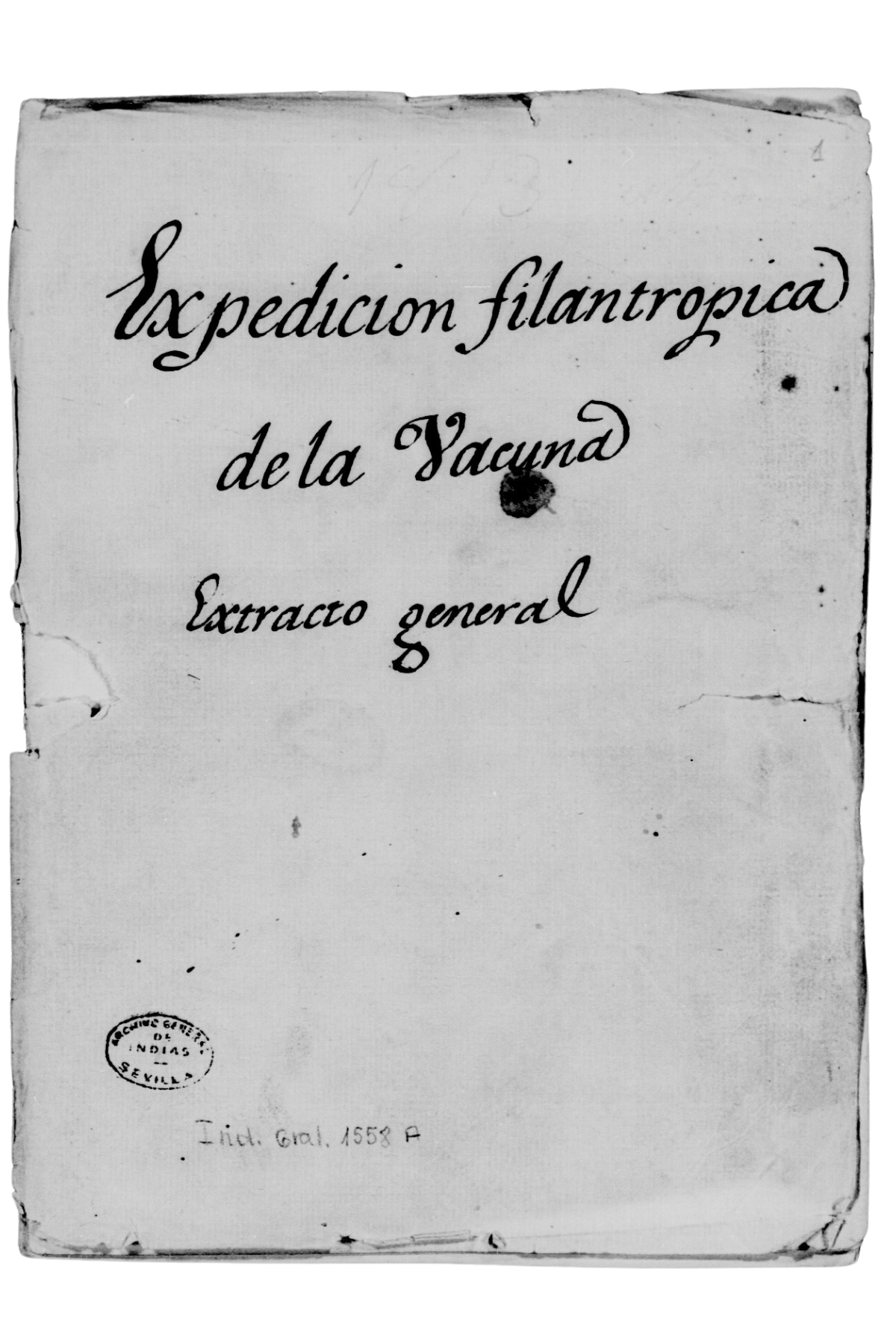
The Balmis's expedition

Archivo General de Indias

Explore

Indiferente 1558A

This set of documents, safeguarded by the General Archive of Indies, is in Sevilla, without a doubt, the most important and abundant collection of manuscripts on the Royal Philanthropic Expedition of the Vaccine. Not only is its relevance recognized by researchers on the subject, but also by UNESCO. In fact, in May 2023, the Indiferente 1558A, along with other documents on the expedition, was inscribed in the Memory of the World Register. Although the physical documentation is no longer accessible to researchers, it is possible to access to the microfilmed version of them.

Unfortunately, in the process of digitizing these materials, one important aspect got overlooked: their classification. What is shown as the content of the Indiferente 1558A in PARES, Portal de Archivos Españoles, does not correspond to the digitized index that accompanied the physical version of it. And to make matters worse, this does not correspond to the quotation used by the researchers who were able to access them physically. This file is far from short; it has 1560 folios (so, in pages, double that number). To navigate around that issue, I elaborated a table that merges the two organization indices provided by the AGI.

Organization of the file

Both the PARES classification and the microfilmed index of this file, one made with a typewriter, follow a similar logic: they group documents around a central theme. I employed this merged classification to locate and determine which sections I would be transcribing. Also, in order to have a clear view of the document each section contains, I used Notion databases to organize them and map out useful details they have that could help in their identification later.

Why there are no pictures of the original documents? As the digitization of this file is not available on the PARES website, I am not allowed to upload the digital copies I have of them.
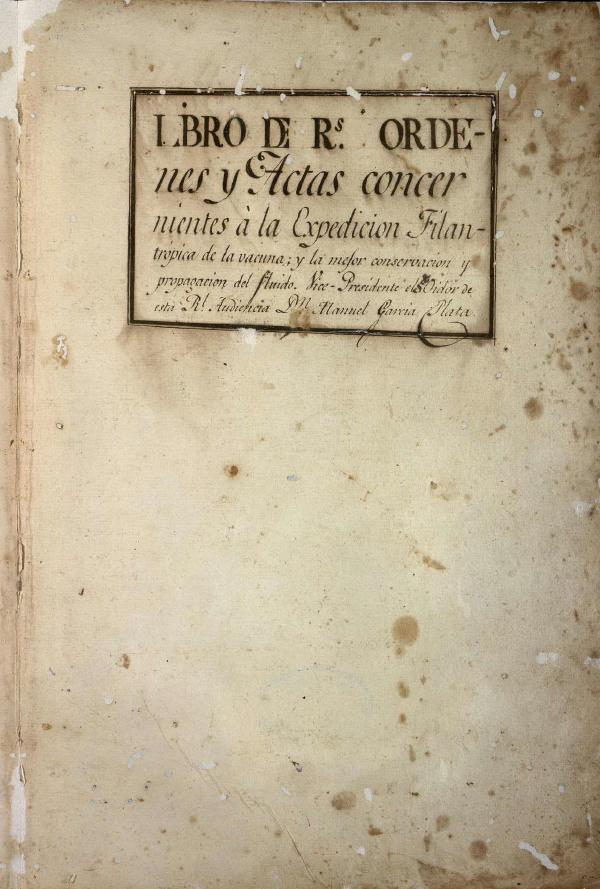
Table of merged organization indices for the Indiferente 1558A:

Fondo del Instituto Nacional de Salud del Perú

Explore

Libro de Reales Ordenes y Actas

While the Indiferente 1558A is widely known, the opposite applies to the Libro de Reales Ordenes y Actas; very little research has been done on it. The only scholars who have properly addressed its content were, first, Enrique Ruiz, in 1904, in his thesis Historia de la Viruela. After him came Ramón Ribeyro, in 1918, who published some of the Actas and the two royal decrees in the Boletín de la Dirección de Salubridad. The last one, who built on the work of the two previous ones, was Juan Bautista Lastres; and it is thanks to his publications that I am able to trace back the first two. Although valuable their contributions are, they did not propose nor attempt a classification or systematization of the information contained in the book. A work like this would have to wait for the 21st century.

A table of contents was prepared by the Department of Registration and Preservation of Archival Documentary Heritage of the National Archives of Peru in 2021. As part of a successful attempt to declare this book, by law, a natural cultural heritage , the National Archives of Peru commissioned Ofelia Mamani Apaza to elaborate a descriptive schema of the contents of the book. A huge table of 39 columns and 65 rows that I cannot reproduce entirely here because it would be unreadable. Here you can check it. Like the Indiferente 1558A, in July 2025, this book was also inscribed in the Memory of the World Register. This document was already transcribed by Celia Miriam Soto Molina in 27th January 2021, as part of the digitization process that the Instituto Nacional de Salud of Peru carried out. Both the scans and the transcription can be accessed here.

I have built up on the work done by Mamani Apaza and Soto Molina, employing some of the parameters Mamani used and adding others. While her classification aimed towards a description of the document as an important piece of the historical collection of the National Health Institute, mine attempts to showcase information contained in the book that helps researchers navigate across the book. Whereas the transcription made by Soto is a literal one, here I present a normalized version of it. For this, I also used a Notion databases.